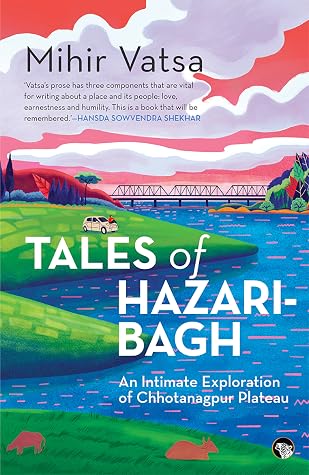
Tales of Hazaribagh: An Intimate Exploration of Chhotanagpur Plateau
byMihir Vatsa
My Rating - 5/5 stars
“These are the days of exile, of desiccated life, of dead souls. To come alive again, one needs a special grace, self-forgetfulness, or a homeland. Certainmornings, on turning a corner, a delightful dew falls on the heart and then evaporates. But its coolness remains, and this is what the heart requires always.”
Return to Tipasa, Albert Camus
Long after I completed reading Mihir Vatsa’s Tales of Hazaribagh, I found myself returning to this essay by Camus. It is my favourite from his collection of Lyrical Essays. A piece of writing that stirs my heart because it speaks of something I can only imagine and try to hold onto in my thoughts – a place you can always return to, a place whether your home or not but where even the smallest part of the land and its sky can make your heart grow fonder for life itself, a place where you not only return to the beginnings but also to that fount of repose which gives you sustenance, a place whose existence is an assurance of the invincibility of summer amidst the darkest of winters.
For Mihir, Hazaribagh is that place.
He returns to his homeland after few years in the nation’s capital, depressed and in search of a sanatorium. Towards the end of the first chapter he tells you that this book is about him and the Hazaribagh Plateau, about him in the Hazaribagh Plateau. It is about the land.
“In January 2017, I was no longer looking to ‘do something’ for Hazaribagh. The Plateau had only just opened up.
It was doing things to me.”
Subsequently, in the coming chapters, he accounts his exploration of different places of the land, embarking into places known as well as unknown. As he chronicles his journeys, his experiences, interspersed with anecdotes from his life, his admiration and even helplessness at times, while observing how with time certain places seem to be set for ruin, the reader is captivated by a sense of wonder.
This book is an account of the places he explores in Hazaribagh, yes. However for me, it is also a study into ways of looking at a place you love because it is your homeland. It is just not about its beauty or history, folklores or the unavoidable march towards ‘development’, but also about its agonies and vulnerabilities.
It is a piece of sheer beauty and is rendered poetically, with a fondness which washes over the reader as well.
I was awed by the writer’s love for his land, by his efforts for its preservation. And to admit very honestly, I even felt a bit envious for I haven’t yet known a place like that, a place I would know like the back of my hand, a place where I might feel at peace, a place I would like to rest, finally.
If there is one sentiment that this book deepens for me, it is that that the home never leaves you, no matter where you go.
Return to Tipasa, Albert Camus
Long after I completed reading Mihir Vatsa’s Tales of Hazaribagh, I found myself returning to this essay by Camus. It is my favourite from his collection of Lyrical Essays. A piece of writing that stirs my heart because it speaks of something I can only imagine and try to hold onto in my thoughts – a place you can always return to, a place whether your home or not but where even the smallest part of the land and its sky can make your heart grow fonder for life itself, a place where you not only return to the beginnings but also to that fount of repose which gives you sustenance, a place whose existence is an assurance of the invincibility of summer amidst the darkest of winters.
For Mihir, Hazaribagh is that place.
He returns to his homeland after few years in the nation’s capital, depressed and in search of a sanatorium. Towards the end of the first chapter he tells you that this book is about him and the Hazaribagh Plateau, about him in the Hazaribagh Plateau. It is about the land.
“In January 2017, I was no longer looking to ‘do something’ for Hazaribagh. The Plateau had only just opened up.
It was doing things to me.”
Subsequently, in the coming chapters, he accounts his exploration of different places of the land, embarking into places known as well as unknown. As he chronicles his journeys, his experiences, interspersed with anecdotes from his life, his admiration and even helplessness at times, while observing how with time certain places seem to be set for ruin, the reader is captivated by a sense of wonder.
This book is an account of the places he explores in Hazaribagh, yes. However for me, it is also a study into ways of looking at a place you love because it is your homeland. It is just not about its beauty or history, folklores or the unavoidable march towards ‘development’, but also about its agonies and vulnerabilities.
It is a piece of sheer beauty and is rendered poetically, with a fondness which washes over the reader as well.
I was awed by the writer’s love for his land, by his efforts for its preservation. And to admit very honestly, I even felt a bit envious for I haven’t yet known a place like that, a place I would know like the back of my hand, a place where I might feel at peace, a place I would like to rest, finally.
If there is one sentiment that this book deepens for me, it is that that the home never leaves you, no matter where you go.

No comments:
Post a Comment