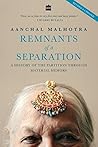
 Remnants of a Separation: A History of the Partition through Material Memory by Aanchal Malhotra
My rating: 5 of 5 stars
I picked up Remnants of Separation because I was looking for books on Partition of India which happened in 1947. I wished to delve into the socio-cultural aspects of the region that was affected most during Partition. Part of it coming for the reason that my Grandmother was born in Rawalpindi and had gone through the pain of leaving her maternal home behind while escaping to this side of the border. Though I do know of some facts as told by her but I never ventured to ask her, while she was still alive, about the tribulations she might have gone through at that time. It might have been because I was young and my mind did not register the import of those events at the time. But what I do remember is her eyes. Sometimes she would just sit motionless, her gaze fixed upon something in distance, but to me, it seemed very sad. I could sense unhappiness though I didn’t realise the cause. It haunts me even now, not knowing what might have transpired in her mind or if she would have liked to tell something. There must be some memories she had too.
In my curiosity to get an idea of the kind of life she might have lived during her childhood and the kind of anxiety or fear she might have gone through, I started looking for books on the subject. It was then that a reading group on FB advised this book by Aanchal Malhotra and I picked it up.
Aanchal tells us twenty-one stories of the people who moved during Partition. She tells the stories through the material objects from those times which still remain with these people, objects which they hold dear. The author also puts a picture of the object before each memory, thus giving a kind of essence to each story. These pictures help us look closer and understand the memories which are associated with these objects, memories which sustain them or memories which they wish had never had the likelihood of shaping if the event hadn’t taken place. They don’t yet understand why Partition took place, why they were uprooted from their land and their homes. Most of them still long to return to their homes, to that land which nourished their souls once.
In the introduction, the author muses over the nature of memory:
Human memory is fragile. We mentally store our experiences as memories. However, it is important to understand that our memory is not a recording device. It cannot be stored as an exact and precise mnemonic trace of that moment, especially when time gradually begins to wear it down.
If you imagine an experience to be the construction of a memory, then its recollection years later can be defined as its reconstruction. As the years pass, memory, inherently malleable, accumulates many perforations that can be filled with new experiences – imagined, fabricated and, sometimes, even a seamless integration of several unconnected memories into one.
Perhaps a seamless integration has been what has happened with people’s memories related to Partition. When we read the account as told by them, we realise that mostly, people do not narrate incidents in a linear manner but as and when something strikes them, sometimes also adding newer experiences they had with these objects after they settled in a new place.
The beauty of the author’s portrayal lies in the manner in which she tells stories. It is always the people, their memories and their accounts which take center stage. She listens attentively, writes empathetically, but she never intrudes in the narrative space of those narrating stories. She maintains a courteous distance, yet her sobriety is reassuring.
All the memories touched me profoundly and sometimes I found myself visualising the events in my mind. Still, there were two memories which left a lasting impression upon me.
These were-
Memory Seventeenth: From the Folds of Life: The Household items of Sitara Faiyaz Ali and
Memory Twentieth: Between This Side and That: The sword of Ajit Kaur Kapoor
Twentieth memory was the most gruesome account of trials of Partition.(view spoiler)It gave me yet another perspective into the working of the human mind in the face of extremities and made me shudder with fear. I wondered if any of those parents lived longer, how they would have continued in their lives. Would a feeling of guilt or remorse have been sufficient to ease the load of their act? But more importantly, could I, who never had to face such fear, ever judge those people?
The Seventeenth memory was about a family which had a summer home in Dalhousie which fell to the Indian side after Partition. That house was very dear to the owner who just had the opportunity to live in it for two summers. According to Sitara Faiyaz Ali, the narrator of the story, it was the dream home of her father which he had built himself brick by brick. While I read and posted an update of my reading progress, I had the fortune of interacting with the author herself. Aanchal posted a link to my Instagram account, asking me to read an article as an accompaniment to that story. The article, by the author herself, recounted how after this book was published, the present resident of that house in India chanced upon the book and read it. When he reached this chapter, he was astonished to find the picture of his home in the book. He contacted the author and the author arranged a video call between people from both sides. When they made a contact via that call, Sitara Faiyaz Ali could see her home again. The present owner showed her around the house and I could sense, while reading that article, how much happiness that act must have brought to her. I felt a sense of gratitude towards the author and thanked her for making me privy to that article, for making me see how the goodness of humankind stands firmer amid chaos and how there is always a hope amidst despair.

A picture of the house from the book
I cannot possibly express in words how these stories have influenced me. And I cannot thank the writer enough for writing such passionate and touching account of stories of people who suffered pain when severed from their homeland. What I do know is that I will always be hopeful, always think of the kindness that is inherently humane and how it does give an assurance of the future even in troubling times.
This book is highly recommended.
View all my reviews

No comments:
Post a Comment