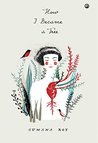
 How I Became a Tree by Sumana Roy
My rating: 5 of 5 stars
“As I removed my watch from my wrist, and clocks from my walls, I realized that all my flaws—and this I now discover I share with many others—came from my failure to be a good slave to time."
Wouldn’t you agree that sometimes when you are reading a work, you come across such sentences which reverberate with your feelings about certain things in life? And that these sentences then help pave the way into a writer’s mind, kind of opening alleyways that lead you to those corners where the thought had first occurred. And that those corners are discovered not only because the writer makes you privy of those thoughts through her writing but also because they are illuminated with a clarity that is alluring. And then you find yourself going deeper and cherishing every moment along the way.
This happened with me while reading “How I Became a Tree” by Sumana Roy. I loved her writing. I loved how she took me onto a journey with her, a journey in the search of a ‘tree time’.
“It was impossible to rush plants, to tell a tree to ‘hurry up’. In envy, in admiration and with ambition, I began to call that pace ‘Tree time’.”
Tired of the way the world moves, Roy wishes to slow down and in order to be doing so, begins to wonder about the lives of trees, about their time. How their world is not affected by the chaos which seems to have engulfed our lives. To correlate the life of trees with that of humans, she starts with planting saplings as a way of beginning. She understands that tree time cannot be equated with our time as trees don’t live like us or have days like birthdays or anniversary days but she realizes that trees can possibly only live in the present. In her journey forward, she reflects upon the ideas like kindness, tolerance, content, silence as could be understood in the realm of trees. She ruminates over the idea of living like a tree, of loving a tree, of having plants as children, of getting lost in the forest or sitting under a tree.
To convey her ideas more clearly she meticulously cites works of writers including poets, essayists, scientists, philosophers and painters as well as anecdotes from her life. So in a sense the work has elements of memoir, essay and even critique which make it much more beautiful. It reminded me of Gaston Bachelard’s “Poetics of Space”, a work I had enjoyed reading tremendously.
I read this work slowly, as it is meant to be. And as I proceeded with the different parts this book is divided into, I realized that they can be related to different ashramas (stages) of life as depicted in Ancient Indian texts, not in a literal but symbolic sense, with each stage the author turning closer to discovering herself in relation to life of trees while brooding over the different stages of human life that we are expected to follow or go through.
The parts include:
I. A Tree Grew inside My Head (Saisava)
II. I Paint Flowers so they will not die
III. See the long shadow that is Cast by the Tree (Tarunya)
IV. Supposing I became a Champa Flower (Yauvana)
V. I want to do with you what Spring does with Cherry Trees (Ghrihasta)
VI. One Tree is Equal to Ten Sons (Ghrihasta)
VII. Lost in the Forest (Vanprastha)
VIII. Under the Greenwood Tree (Sanyasa)
IX. The Tree is an Eternal Corpse (Mokhsa)
In italics are the stages in Indian context as I could grasp. I am not really sure whether these were intended by the author in the same manner or not.
This book is a wistful account of the compulsiveness to escape the chaos as experienced by humans in a fast moving world where we have wilfully forgotten the pleasure of living a slow (read ‘unhurried’) life which is the natural disposition of trees and perhaps, of ours too. So the author’s journey to become a tree is more of a journey to rediscover the simplest things in life, things which make us more tolerant, kind and more human.
I must say that it is one of the most compelling works of contemporary Indian non-fiction I have read in a while. Highly recommended.
View all my reviews

Thanks for sharing your review mam. I would definitely read this one.
ReplyDelete