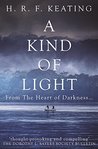
 A Kind of Light by H.R.F. Keating
My rating: 3 of 5 stars
“Long is the way and hard, that out of Hell leads up to light.”
John Milton, Paradise Lost
Conrad’s Heart of Darkness is an exploration, not only into the Dark Continent but also of the darkness of human heart. Marlow’s search for Kurtz, who descended into the inferno, divulges the evil on the prowl. But a journey into the Dark is also necessarily a journey in search of the Light.
Perhaps this is what motivated H.R.F.Keating to write a novel as homage to Conrad’s masterpiece. And we come across striking similarities between two works.
In the HOD, Marlow sets on a journey in search of Kurtz whose enigma mystified him. In AKOL, Tom (Theresa) sets out on a journey to find Thomasina’s last volume of diary, whose other volumes she comes across after almost 100 years of the woman’s exploration into the dark forests to find a magical herb. Whereas in HOD, Marlow comes across a horrific facet of the tribal people, in AKOL, Thomasina and even Tom witness the generosity of tribals in the way they are helped in their respective journeys. In HOD, towards the end, we observe the horror as pointed by Kurtz, who couldn’t resist the temptation to become one with the evil ways of tribals, in AKOL, we witness how the last volume of Thomasina’s diary turns out to be empty because she finds her true happiness as she finds love in the forest.
But whereas the HOD focuses only on the dark and evil pervading the dark forest and human mind, AKOL focuses on the good. Though the HOD is referred to by the characters in the work, the reference doesn’t situate the context with the work rightly. Although I liked the idea of Keating to treat the journey into dark as that towards light, but it doesn’t come across as homage to Conrad’s masterpiece as mentioned in the blurb.
The narrative style is alternative. The voice shifts from epistolary to third person and vice-versa continuously. That is, we read through Thomasina’s diary and Theresa’s journey alternatively. But the glitch here is that though Thomasina’s account is smooth and gripping, the dialogue between Theresa and other characters or the third person narrative sounds hackneyed. It makes one wonder if the whole text was written in the diary style, would it have served the book better?
Still this work has its own charm and some snippets from the diary are worth reading and contemplating. Here are some of the quotes that I liked:
"I'm sorry", he said after a little. "But I just hated the thought of it all. I don't know. It seemed like a terrible,futile pathetic attempt to impose order on-on what isn't ordered. Those drums beating out that rhythm,not to send any message, but to try to say everything's right,everything's good. God's in his heaven and we're thumping out some nice music."
"I write for a few minutes before we attempt to find our way round, or force our way through the terrible matted tangle that lies in our path. I should be filled with new resolution. But my night was so afflicted with dreams, no, by one nightmare of appalling vividness, that I find myself prey to a dragging unwillingness to set one foot in front of another. I do not know why I should have been so enmired as I slept."
Before reading this work, I hadn’t come across the author’s name which is surprising because Keating has produced a good volume of work, most of it being crime fiction and one series called Inspector Ghote being written with Indian background. Some of his works have also been made into movies (one volume turned into a movie starring Nasserudin Shah, a famous Indian actor). He has also won some awards and was a prominent crime book reviewer for the Times.
I would sure like to delve into his crime fiction and other works to explore the writer.
*3.5 Stars
P.S. Thanks to Endeavour Press for a copy of the work to review.
View all my reviews

No comments:
Post a Comment