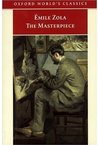
 The Masterpiece by Émile Zola
My rating: 5 of 5 stars
'Ah! life! life! to feel it and portray it in its reality, to love it for itself, to behold in it the only real, lasting, and changing beauty, without any idiotic idea of ennobling it by mutilation. To understand that all so-called ugliness is nothing but the mark of individual character, to create real men and endow them with life, yes, that's the only way to become a god!'
Perfection is the sole intention of an artistic endeavor striving towards greatness. In this effort lies the innate desire of an artist to conquer the imaginative world of his creation. To conquer it in such a way that his creations are perfect portrayal of those ideas which his mind perceives and of those which he lives by too. Even when he realizes that perfection in reality is unattainable; it is still the only impetus that drives his passion. A passion fueled by the long coveted glory in the real world. If his passion is continuously thwarted when confronted with real world, the artist may fall into that ruinous abyss from which there is no escape - from which he doesn’t really wish to escape since for him it is only his art which matters, which is real, and everything else is inconsequential. He may rather die for his art than live for something else in the world.
'Yes, I belong to that god; he may do what he pleases with me. I should die if I no longer painted, and I prefer to paint and die of it. Besides, my will is nothing in the matter. Nothing exists beyond art; let the world burst!
L'Oeuvre or His Masterpiece from the series Rougon-Macquart by Emile Zola, set in second half of the nineteenth century Paris, is a striking rendition of the life of such an artist in the City of Light. Claude Lentier is a revolutionary painter who produces paintings after paintings only to be rejected by the Salon every year. He knows that it is because he doesn’t follow the traditional style, he would rather starve than compromise his art. Finally, the rejections take its toll on the painter who, after struggling too much, loses the very art which he wants to perfect. More he works on his paintings, more he spoils them in his zealousness. Till in the end, after losing everything, he dies for his art.
This work, which is the fourteenth book in a series of twenty volumes, is not only one part in the story of two families followed through generations by Zola but it is also a work which stands apart for its own literary merit. I haven’t read any other volume but have read somewhere that L'Assommoir and Germinal are the best in the series. Surely, L'Oeuvre has inspired me to read other volumes too.
It is well known that many of the characters of this work were drawn from real life artists. Ernest Alfred Vizetelly, in the preface to work, provides an account of various people and incidents which went into the creation of this novel; two major characters being the protagonist Claude Lantier (inspired by Cezanne and Manet) and his closest friend Sandoz (based upon Zola himself).
In the words of Alfred:
Claude Lantier, the chief character in the book, is, of course, neither Cezanne nor Manet, but from the careers of those two painters, M. Zola has borrowed many little touches and incidents. The poverty which falls to Claude's lot is taken from the life of Cezanne, for Manet was the only son of a judge and was almost wealthy….Whilst, however, Claude Lantier, the hero of L'Oeuvre, is unlike Manet in so many respects, there is a close analogy between the artistic theories and practices of the real painter and the imaginary one. Several of Claude's pictures are Manet's, slightly modified. For instance, the former's painting, 'In the Open Air,' is almost a replica of the latter's Dejeuner sur l'Herbe ('A Lunch on the Grass'), shown at the Salon of the Rejected in 1863. Again, many of the sayings put into Claude's mouth in the novel are really sayings of Manet's. And Claude's fate, at the end of the book, is virtually that of a moody young fellow who long assisted Manet in his studio.
Being a Parisian, Zola had acquired that artistic fervor which throbbed as life in the pulse of the artistic City. Owing to his friendship with painters of the time, the ideas which hence found an expression in the writing of this work by Zola are rendered akin to masterly strokes in a painting by a painter. Here the city is itself seen through the eyes of a painter as Claude walks in the streets of city looking out for an inspiration. Quoting Alfred again:
From a purely literary standpoint, the pictures of the quays and the Seine to be found in L'Oeuvre are perhaps the best bits of the book, though it is all of interest, because it is essentially a livre vecu, a work really 'lived' by its author.
The work ‘Lived’ in the sense that the thoughts and philosophical ideas occupying the minds of both Claude and Sandoz, are those of Zola himself. The exasperation felt by Claude, after being frustrated with his work, while roaming the streets of Paris, was that felt by an unemployed Zola too. His writing delves into Naturalism as well as impressionism as he illustrates the life of Claude and his paintings. His promotion of the school of “Open-Air” can be distinctly identified with the title of Claude’s first painting “In the Open Air” exhibited by the Salon of Rejected. He was an ardent admirer and supporter of Edouard Manet, the first real master of Open Air School, and had anticipated the significance of painter’s principles and methods. It is these methods and principles which he associates with Claude here.
In the voice of Sandoz, a novelist, Zola puts his own words when he expresses his views regarding the futility of extreme efforts taken by Claude at the expense of his family and his life.
'Look here, old man, I, whom you envy, perhaps, yes, I, who am beginning to get on in the world, as middle-class people say. I, who publish books and earn a little money as well, I am being killed by it all. I have often already told you this, but you don't believe me, because, as you only turn out work with a deal of trouble and cannot bring yourself to public notice, happiness in your eyes could naturally consist in producing a great deal, in being seen, and praised or slated. Well, get admitted to the next Salon, get into the thick of the battle, paint other pictures, and then tell me whether that suffices, and whether you are happy at last. Listen; work has taken up the whole of my existence. Little by little, it has robbed me of my mother, of my wife, of everything I love. It is like a germ thrown into the cranium, which feeds on the brain, finds its way into the trunk and limbs, and gnaws up the whole of the body.
As a protagonist, Claude is not a very likeable character. He fails as a painter, as a husband and even as a father. His extreme step of committing suicide doesn’t really surprise nor does it evoke anger or any pity. This according to me is the triumph of Zola as a writer. It is his straight forward style as a realist and naturalist writer which succeeds in the life like description of an artist struggling in a city where the custodians of art adhere to long accepted traditional styles and where the audience of such art follows the popular opinions tossed about by a handful of average artists.
The only thing that shocked me while reading this novel was the painting -“The Dead Child” by Claude which was at last accepted by the Salon. The description of this painting came right after the death of Claude’s son (who died for utter neglect on the part of his parents) and for a brief moment I felt stupefied at the thought that the painting could have been painted by Claude right after his son died. Since we do not witness any mourning for the child by his parents, it appeared as a possibility that Jacques’ death could have provided Claude with a picture to paint. Ironically, this is the picture accepted finally by Salon which proves a precursor to Claude’s death.
View all my reviews

No comments:
Post a Comment