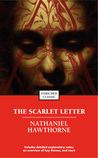
 The Scarlet Letter by Nathaniel Hawthorne
My rating: 3 of 5 stars
Difficult as it is to come to an acceptable idea of existence, it is interesting to study the social evolution of mankind in terms of ethics, values and morals held or dogmas followed. It helps to gain some coherence when coming to terms with the understanding of the rules of the society we make a part of, more importantly, to question certain unreasonable dogmas and beliefs while still considering the sensitive nuances forming the very fabric of society. The contemplation which so verily stimulates the mind to question also makes it ponder upon the beliefs which we may follow unconsciously only because our minds are conditioned for them. Beliefs which may not hold much significance if viewed objectively but still influence options considered or decisions made in life.
A reading of The Scarlet Letter accompanied such contemplation. Much as there was to think about the beliefs and dogmas that prevailed in a puritan society, the punishment indicted upon Hester or the revenge sought by Chillingworth, what troubled me more was the idea of sacrifice as portrayed which made the characters somehow larger than life and hence alienated. Hester’s devotion to Dimmesdale, the clergyman, was contradicted by her decision to stay back at the same place. It was quite understandable in the beginning only that her presence would be unfortunate for him. Her character, though she being the protagonist, was not as explored as were the characters of Chillingworth or that of clergyman in the sense that we had little idea about how she felt about being adjudged as an adulterous woman or why she decided to stay back in the same place. Though she is presented as an admirably strong woman who walks with her head high and adorns her child in the best possible manner, it is puzzling that she lacks foresight.
What the character of Hester lacked was explored and portrayed at length in her daughter Pearl’s character. She was sensitive, impulsive and instinctive and seemed to possess more clarity. Dimmesdale’s character is the one fully explored and somehow to me it is also the weakest character in the story. As a clergyman dedicated to divine intervention and religion, he is the one who is pretentious. His decision to stay silent and let Hester bear the punishment, even if for the purpose of remaining true to his position and not ruining people’s faith while tormenting himself, is incongruous with the very ideals he seem to be advocating or protecting. And though we witness a hint of malevolence in him towards the end, when he feels tempted by the prospect of going far away with Hester, he is redeemed in the end by his confession, by his acceptance of Hester and Pearl and by taking up the scarlet letter himself.
I couldn’t understand the author’s intention here though. Did he just attempt to portray a true event or did he mock the hypocrisy of a so called puritan society?
Either way, the work did succeed in making the mind deliberate upon human nature and upon the extent to which societal beliefs impact the choices made by an individual.
View all my reviews

No comments:
Post a Comment