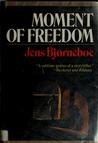
 Moment of Freedom: The Heiligenberg Manuscript by Jens Bjørneboe
My rating: 5 of 5 stars
Ablaze in the anguish of a never ending human conflict, the ghost of humanity rises from the ashes in unnerving bestiality. Towns, cities, countries are engulfed in its uproar as it sweeps across. The torrent it causes upshot a cataclysm which spares no one. Unheard of crimes become possible; streets turn red, speckled with excrement of sordid actions. Mutilated souls wander through land of chaos unleashing havoc upon those still blameless. Humanity keeps dying and the cycle continues.
The only peace attained is illusive; an adherence to injustice, to tolerate unfreedom, to cure oneself of the burden of impossible freedom. The narrator, a servant of justice, keeping up with his task of recording history of bestiality, is not seeking consolation or crushed virtues. He accepts what cannot be undone and suffers from knowing too much.
“I'm not searching for a lost identity. Quite the contrary. I suffer from an excess of identity, from an ego which is as solid and massive as a boulder. How did all this prodigious identity arise, what substance is it made of, how did this existence get its massiveness?”
The onerous realization abounds a state of melancholy; vague dreams and reality overlap as the line between morality and decadence recede. The words rise to fill the pages, shaping in images of unfortunate people killed in wars or subjected to mass experiments in the mad pursuit of scientific ends, in sexual abuse of children or their mass murder for who needs the burden of worthless children of war, in innocent people turning murderers all of a sudden for the sleeping demon of bestiality woke up to claim its fodder. Bleeding sky sentences the peace of mind. And amidst all this, life still continues on the ration of indifference. An indifference not innate but acquired as the sole sustenance for survival, aided with wine, brothels, paintings and laughter too.
But can this survival by indifference, despite of deep melancholy, be called a state of freedom? A freedom since the mind is conditioned to remain unaffected? Or is freedom the right to exercise as much brutality? Is Power freedom? Or is the unconscious submission to forced ideals freedom? When does the moment of freedom really arrive? Does it only come in the face of death when all illusion is finally lifted or when one takes responsibility?
“At the last stage of alienation, that of becoming irrelevant to oneself, freedom arises: to evaluate everything, a murder or the saving of a life, anew and independently of any code of laws: according to one's own reckoning, here and now. It's a revaluation of all norms, on one's own responsibility.”
Or does the moment of freedom arrive when one accepts the truth?
“When you take our world and peel all the lies off it, then it looks like this: Berlin. The city of stone. The city of ruins. The war has left us like that. We've hardly progressed a step. If one takes away the lies, then we're just standing still. This may sound strange, but the sight of this truth about the world gave me the first feeling of freedom which I'd had in many years.”
What can be said of that. Can the moment of freedom for the reader be the same as that of narrator? For the world is still a chaos, even for all the progress since Second World War, we have hardly progressed further. The ghost of humanity is still at large.
The narrator’s pen rests with an awareness of the gruesome pool of viciousness through which we still wade.
View all my reviews

No comments:
Post a Comment