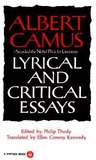
 Lyrical and Critical Essays by Albert Camus
My rating: 5 of 5 stars
For a man indifferent to despair and happiness, what does it matter if the sun rises everyday and then the day proceeds habitually in its entire splendor. For a man torn between Yes and No, what does the love of his land matter. For a man who expects nothing, what does a passion hold? How does a burdened heart embrace the joy of living? And yet, it is this contradiction which defines most of Camus’ writing and thoughts, his ideas of life and living. His despair stems from a deep love, despair because he loves life too much not to be selfish. His passion is unnerving because it poses a question on the accepted notions of happiness and makes one wonder if this happiness that we talk of and experience or imagine to experience, is just a form of escapism. This evident contradiction is viewed with skepticism by many critics who question these inconsistencies in his ideas. However, they are not the ideas of an established or esteemed philosopher, but those of a rebel, of a man hopelessly in love with life in an absurd world, of a kind heart which seeks harmony in the existence, a refuge in solidarity. What makes him uncomfortable to read is that he doesn’t offer solace or hope but a glaring truth whose brightness overwhelms. But then he also offers love; honest and uncompromising. And it is not surprising that the indifferent heart of a stranger could also be filled with immense joy….
To understand the nature of his rebel, it is essential to read through the Lyrical essays. Written from 1935 when he was relatively unknown to 1954, by the time he had already published significant works, Lyrical essays compile his personal musings, but thereby also offer a glimpse into the origin of ideas behind some of his fiction and non-fiction. The section “Betwixt and Between” and “Nuptials” were published in 1937 and 1938 respectively and “Summer” in 1954. The initial two sections are often labeled as his naïve works not only because they were written when he was barely 25-26 years of age but also because they seem to bubble with an exuberance and restlessness distinctive of young age as compared to his more mature works later. But these essays are as profound as his later works. In the first section, he seeks to understand and accept the struggle, giving words to those thoughts which plagued him. In “Nuptials”, he is more a poet who praises the beauty of nature and speaks of its inevitable bonding with man, of the necessity in wake of absurdity, to return to it. In “Summer”, he celebrates the spirit of mankind and emphasize those ideas which man, in his view, must cling to make this life meaningful, those places or the lands to which they must return to feel one with life again.
What also characterizes these essays is the distinct style in which they are written. Camus writes in a lucid manner. His writing is terse when he speaks of the injustices suffered by man in this indifferent universe or of the inevitable fate that he is destined for, but on the other hand it is lyrical in a delightful manner when he speaks of the beauty associated with life. And both of these combine to create that harmony which he also always searched for, a harmony between despair and happiness. His writing style is striking because it is sincere, because it is an honest reflection of his inner self and his thoughts, a reflection also of a man who lived by what he wrote.
“O light! This is the cry of all the characters, who in classical tragedy, come face to face with their destiny. Their final refuge was also ours, and I now knew that this was so. In the depth of winter, I finally learned that there lay within me an invincible summer.”
This quote possesses a subdued expression of rebellion. Subdued, because it accompanies not only the acceptance of absurdity, of that unavoidable fate, but also a certain joy in the knowledge of that invincible source from which the passion of life springs forth and calms the mind; source which keeps us pushing further, to which we return again and again, in turbulent as well as happier times. Source which stands unperturbed, spreading warmth and illuminating heart with its shine. Like Algerian sun to which Camus returns so often, I find myself returning to his works --- again and again. I have found in his writing that source whose radiance fills me with an unspeakable joy. A joy, for it doesn’t deceive the senses but lay open everything in this world in its bareness, whether in beauty or repulsiveness. It doesn’t lead to pine hope but to accept this world, as well as oneself, in entirety. But this acceptance doesn’t equate with weariness, instead it imbues the heart with a passion to live, to love, to be kind.
To me his writing is like that home where peace is granted - a resting place.
These essays are highly recommended to those who seek to live life passionately.
View all my reviews

No comments:
Post a Comment