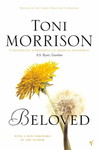
 Beloved by Toni Morrison
My rating: 5 of 5 stars
The clear blue sky above, the richness of life around, stretching from the vivid colors in the nature to the exquisiteness that material life offers. The soft milky ambrosia not once maligned by the sweat of forced labor, the promise of a day to mull over existence for the mind is not strained with the thought of an empty stomach. Granted free thought. The assurance of a smile on your kid’s face for he has never known deprivation or fear. The assurance of a smile on your face for you have always been able to look after him. Disassociation is not even a distant possibility. No ghosts looming in the backyard or playing with your mind for no beloved ever died an unnatural death. This is your world. But did there ever exist different worlds in this world; a world different from ours? One waking up everyday to a beautiful blue dawn and other where the night never seemed to disappear, a world denied to its living, where to realize one’s heart beat was a luxury unaffordable, a world with no colors save that of a grey or earth-brown so that when red came, it turned it upside down?
‘Beloved’ existed in that world. An existence hanging between the living and the dead, furious to take a revenge for the life it could be, forbidding her people to forget the vicious past and prohibiting them from coming to terms with freedom. For the milk she was deprived of, she thought it befitting to suck life out of her mother. Beloved. Her mother’s daughter, whose life was taken by her mother because she couldn’t see her die. Since she was given red, she wanted to be called red.
Beloved; a poignant prose with so many layers that it is difficult to address it in few hundred words, an account of forced slavery and its repercussions, blind love of a mother and unspoken ties, female sensitivities and words unuttered, beliefs and disbeliefs, complete resignation and utter shock. Beloved is this and more.
It is a bewildering chronicle of distraught slaves under the strain of Fugitive Slave Law pre Civil War and the horror of Middle Passage (1), the “Unspeakable things Unspoken”(2) according to Toni Morrison. It is a sad tale based upon a true story of one Margaret Garner, who killed her own daughter rather than let her grow up to be a slave. It is a portrayal of horrid human hunger for emotions and their affirmation. It is an account of need of freedom not only from the external bondage but also from the self trapped somewhere in the past. It is a saga of a child deprived of her first recognition, in form of a relation with her mother, as a human and a living entity.
Toni Morrison wove magical realism through this work where years as well as characters permeated the boundaries of time and progression only resulted in diminishing the limits further. While her prose reminded of One Hundred years of Solitude by Gabriel Garcia Marquez, in this passage her writing seemed akin to Beckett’s in The Unnameable, seeping through present, past and future and loosing a sense of consciousness:
She played with me and always came to be with me whenever I needed her. She's mine, Beloved. She's mine. leaves she puts them in a round basket the leaves are not for her she fills the basket she opens the grass I would help her but the clouds are in the way how can I say things that are pictures I am not separate from her there is no place where I stop her face is my own and I want to be there in the place where her face is and to be looking at it too a hot thing All of it is now it is always now there will never be a time when I am not crouching and watching others who are crouching too I am always crouching the man on my face is dead his face is not mine his mouth smells sweet but his eyes are locked some who eat nasty themselves I do not eat the men without skin bring us their morning water to drink we have none at night I cannot see the dead man on my face daylight comes through the cracks and I can see his locked eyes I am not big small rats do not wait for us to sleep someone is thrashing but there is no……..
A consciousness forced upon by decades of slavery, mistrust, fear and psychological tussle with one’s self, so that loosing it seemed a way to freedom. Consciousness Sethe resigned from, so as to snatch freedom for her beloved; a freedom from being a slave, a freedom by murder.
Beloved, whose infant self is denied her mother’s proximity, when back, always starves for her love, her presence and her attention. Ravenous and never satisfied, she feeds on Sethe’s self, growing herself larger and larger while her mother becomes smaller and smaller. Denver, Sethe’s other daughter, who once welcomed Beloved in the house for she too needed some form of emotional recognition in society, manages to come out of her sister’s spell and seeks help. Paul D, shattered by the disturbing presence of Beloved and unable to make a place in the family, finally leaves the house. 124 full of Baby Venom. It is only when Denver seeks help from the clan and people come forward, that Beloved leaves the place and disappears from their life.
But Beloved not only stands for a lost hungry child craving for love. She signifies the blood of all those slaves who died in the Middle Passage or perhaps were murdered. The blood’s color is red. In her persuasion to Paul D to call her Red, she is forcing Paul D to remember the past and all the murders. Her ghost, which represent the trapped inner self of slaves, comes back to dampen their spirit even when freed. The trapped self; who is too overwhelmed to appreciate freedom, is unable to shake off the horror of past and wants to live in denial of its freedom. But in making her go away, Morrison seems to be giving a very powerful message indeed. The message that it is possible to come out of the ghosts of a terrible past; that it is possible to claim freedom and ownership when one becomes a part of social environment which recognizes and affirms its presence. In this message, Morrison seems to keep in mind the native African traditional beliefs of healing collectively which Baby Suggs was shown to practice too in the clearing.
Deep reverence for this tribute by Toni Morrison for those “Sixty million / and more” who have remained largely "disremembered and unaccounted for".
-----------------------------------
1. W.E.B. DuBois in The Suppression of the African Slave-Trade to the United States of America, 1638-1870, states that "from 1680 to 1688, 249
ships sailed to Africa, importing 60,783 Negro slaves, after losing 14,387 on the middle passage delivered 47,396 in America.Historically known as the Middle Passage, the slave trade spanned the expansion of Europe from the sixteenth century, culminating in America in the late nineteenth century. The slave trade effected the
death, deracination, and abduction of millions of Africans who, boarded like cattle on numerous slavers, were sold at various ports of call.
2. From Toni Morrison's "Unspeakable Things Unspoken: The Afro-American Presence in American Literature," Michigan Quarterly Review, 28, No. 1 (1989), 1-34 where she speaks about two "unspeakable things unspoken" in the bulk of American literature and hitherto marginalized in American history: the horror of the Middle Passage and the horror of slavery as portrayed in Beloved.
View all my reviews

No comments:
Post a Comment