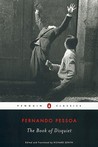
 The Book of Disquiet by Fernando Pessoa
My rating: 5 of 5 stars
“My soul is a hidden orchestra; I know not what instruments, what fiddlestrings and harps, drums and tamboura I sound and clash inside myself. All I hear is the symphony.”
An Orchestra of over 70 musicians, playing their own instruments, each producing an individual sound, a discrete voice, adding up from each corner, playing the distinctive notes of solitude, dream, rain and tedium, rising at one place while falling at another and producing a symphony so striking in its completion that it cannot be complete, like a painting frozen in time, striving for an expression it cannot possibly attain, and not because the painter isn’t skillful enough but because he chooses not to part from one, deliberately made imperceptible in the strokes, which is inherently his own. So while he did create 81 heteronyms* , each distinctly dissimilar in their style, we do not yet know who Pessoa actually was or what he believed in.
Fernando Pessoa, strictly speaking, doesn’t exist.*
Pessoa called this work as his “factless biography” I also came across the words “Psychography” and “geography of self awareness” for the book. In my opinion, it has distinct tones of the absurd, and can be looked upon as an absurdist writing albeit on an altogether different level, though the hints of stoicism and cynicism are apparently evident too. You will not notice the “babble/despair” - characteristic of Beckett’s writing or “Rational absurd” (view spoiler) - quintessential trait of Camus’ writing, but a willful approach towards attaining the disquietude because his consciousness is a tedium resulting from the conclusion of senselessness of existence; an existence not of this world or life but his life.
“It sometimes happens, more or less suddenly, that in the midst of my sensations I’m overwhelmed by such a terrible weariness of life that I can’t even conceive of any act that might relieve it. Suicide seems a dubious remedy, and natural death – even assuming it brings unconsciousness – an insufficient one. Rather than the cessation of my existence, which may or may not be possible, this weariness makes me long for something far more horrifying and profound: never to have existed at all, which is definitely impossible.”
His conviction of being a passer-by reminds me of Beckett’s belief of being a passer-by who finds himself over and over again (The Unnameable).
“This is my morality, or metaphysics, or me: passer-by of everything, even of my own soul, I belong to nothing, I desire nothing, I am nothing – just an abstract center of impersonal sensations, a fallen sentient mirror reflecting the world’s diversity. I don’t know if I’m happy this way. Nor do I care.”
To overcome the anguish of life which he is so acutely aware of, he engages in imagination and dreaming. Perhaps this is the reason he created so many personalities, so as to be able to experience different lives within him. In fact, his approach is distinct in the sense that he is not only aware of his sensations, but he also exercises a control over them which is clearly visible from the number of heteronyms he created for himself, who could each write in distinct literary styles. According to him:
“My intellect has attained a pliancy and a reach that enable me to assume any emotion I desire and enter at will into any state of mind.”*
This writing, which is a compilation of over 500 fragments, where each fragment, written perhaps on different days, seemingly an attempt at expressing the flow of thoughts or imagination capturing writer’s mind, does seem to have a structure in thoughts and more than often talks about solitude, dream, tedium and rain.
“It’s so hard to describe what I feel when I feel I really exist and my soul is a real entity that I don’t know what human words could define it. I don’t know if I have a fever, as I feel I do, or if I’ve stopped having the fever of sleeping through life. Yes, I repeat, I’m like a traveller who suddenly finds himself in a strange town, without knowing how he got there, which makes me think of those who lose their memory and for a long time are not themselves but someone else. I was someone else for a long time–since birth and consciousness –and suddenly I’ve woken up in the middle of a bridge, leaning over the river and knowing that I exist more solidly than the person I was up till now. But the city is unknown to me, the streets are new, and the trouble has no cure. And so, leaning over the bridge, I wait for the truth to go away and let me return to being fictitious and non-existent, intelligent and natural.”
Keeping in mind that this work is written by Bernardo Soares, the heteronym considered to be the closest to Pessoa’s real self, these lines acutely express Pessoa’s yearning to live an imagined life, as if in a dream, so as to forget his actual self in real life. He writes about his dreams, their nature and importance and goes as far as giving advice regarding them:
“Live your life. Don’t be lived by it. Right or wrong, happy or sad, be your own self. You can do this only by dreaming, because your real life, your human life, is the one that doesn’t belong to you but to others. You must replace your life with your dreaming, concentrating only on dreaming perfectly. In all the acts of your real life, from that of being born to that of dying, you don’t act – you’re acted; you don’t live – you’re merely lived.”(Art of effective dreaming II)
Rain, which frequently appears in the text, seems a symbol of the incessant thoughts, pouring over writer’s mind and submerging his awareness in the disquiet that he experiences:
“Each drop of rain is my failed life weeping in nature. There’s something of my disquiet in the endless drizzle, then shower, then drizzle, then shower, through which the day’s sorrow uselessly pours itself out over the earth. It rains and keeps raining. My soul is damp from hearing it. So much rain… My flesh is watery around my physical sensation of it.” ( Rainy Landscape)
He profoundly expresses his tedium in words when he experiences it and also present to us different situations where one may feel tedium:
“Tedium… Perhaps, deep down, it is the soul’s dissatisfaction because we didn’t give it a belief, the disappointment of the sad child (who we are on the inside) because we didn’t buy it the divine toy. Perhaps it is the insecurity of one who needs a guiding hand and who doesn’t feel, on the black path of profound sensation, anything more than the soundless night of not being able to think, the empty road of not being able to feel…”
And what is still more astonishing is that though he wrote these fragments in solitude, over perhaps a decade or more, he wrote it as a dialogue between him and the future reader, allowing for either acceptance or rejection on the part of reader.
And I offer you this book because I know it is beautiful and useless. It teaches nothing, inspires no faith, and stirs no feeling. A mere stream that follows towards an abyss of ashes scattered by the wind, neither helping nor harming the soil..... I put my whole soul into making it, but without thinking about it as I made it, for I thought only of me, who am sad, and of you, who aren’t anyone. And because this book is absurd, I love it; because it is useless, I want to give it away; and because it serves no purpose to want to give it to you, I give it to you…
As I conclude my review, I want to admit that this book overwhelmed me immensely, I witnessed Pessoa seeping inside me slowly, making me quiver with the words he spoke to me, more as I understood them. Perceiving the disquiet which so fiercely plagued him, the solitude that he opted to dream to somehow conquer it, but still returning to the unrest because he understood the futility, made his thoughts trace through my mind, linger there for sometime before finally coming home to me. But my effort at writing a more personal review didn’t ensue because if written, it would have been nothing but babble.
I am yet to complete reading Philosophical essays by Pessoa and the poems he wrote by the name of Albert Caeiro, but still I feel privileged to place him on the altar alongside Camus and Beckett.
---------------------------------------
*source - wikipedia
*Written by his creation, Álvaro de Campos, Notes for the Memory of My Master Caeiro (Editorial Estampa, 1997).
*From a “Personal note”, 1910
View all my reviews

Thank you Rakhi! Loved all the paragraphs that are in quotes. Appreciation for your review! Keep reviewing....
ReplyDeleteGlad you liked it. The paragraphs in quotes are from the book itself, the work of author :) I loved the book. I'll keep reviewing, yes. Thanks again!
ReplyDeleteThank you for reply. I think existence (whatever quiet or disquiet :d) is like a Still Lake, the moment you try to know it--bubbles and waves start coming to it; more efforts, more bubbles and waves. And if you "don't" try to know it, a question ever comes "Who are you?" And, perhaps for some people, this question never comes...and for some, the answer not so easily come.
ReplyDelete