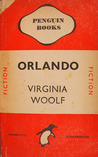
 Orlando by Virginia Woolf
My rating: 5 of 5 stars
As always, Woolf has stunned me with the magic of her prose here. Telling this isn’t important, neither that it is a biography; that it informs us about the affair of Vita and Violet. I guess much has been said about that. When I started reading, I had no idea about the references to people, places, their characters or their lives as are known to be mentioned in this work. In fact, as the novel proceeded from Orlando’s gender change for the first time, I had a notion about the invisible layer of narrative which Virginia had experimented with, in this work. And as the work moved through centuries, I realized that the notion was making sense.
I didn’t even read it as something related to gender issues, though they might as well have been mentioned or portrayed deliberately, specially with reference to Pope, Addison and Swift.
To me, Orlando, in its truest sense renders the spirit of literature of the respective times it refers to, as it proceeds in time. The different centuries starting from Elizabethan and Jacobean to Restoration, Augustan, to Age of Sensibility, Romanticism and finally to Victorian, have been depicted in the form of exploration of the human mind. In any age, as it holds true, the people are influenced by the spirit of the age, which in turn reflects in the literature of the respective age, so Orlando is one finest description of Zeitgeist.
Orlando’s love affair with Sasha symbolizes the passionate extremism of Elizabethan period, while his engagement with reading and writing poetry attributes to characteristics of Jacobean period. During Restoration period, Orlando is sent as an ambassador to Constantinople, whereas the Age of Enlightenment or Augustan lets her see right through the poets like Pope, Addison and Swift and makes her wonder at their foibles. In nineteenth century or the age of realism, Orlando, as a woman, realizes that she needs to marry to secure her social standing. Her marriage to Shelmerdine might actually be a depiction of the European Romantic movement reaching America in early nineteenth century.
The Victorian age, witness the coming of Orlando in terms of herself as a woman or a writer and thus represents the increased role of women as a reader as well as a writer during that age. And the present time i.e. 11th October 1928, when the novel is published, we observe that Orlando is happy with the changing times, that she has finally arrived there, which cannot be neglected for the fact that the work was published when Woolf’s writing was at its height in terms of its popularity.
I am in awe of Woolf for her eagerness and will to experiment with the style of prose and her aversion to the well accepted norms of written word during her times. A profound expression of her ideas about how to write, what to write and for whom to write i.e. the relationship between a writer and a reader, can be witnessed in her essay Mr. Bennett and Mrs. Brown.
View all my reviews

No comments:
Post a Comment